


SukhoThai Blogs
Unlock insights with our recent articles

 Sep 2026
The Wisdom of Lord Ganesha: Lessons in Calm, Balance, and Positive Beginnings
There is a particular sound that marks the start of Ganesh Chaturthi in most Indian homes, not the aarti bells exactly, not yet, but the smaller sounds that come before them. A drill boring into a wall to hang one more string of marigolds. Someone tested the volume on "Ganpati Bappa Morya" three times before deciding it was loud enough. The clatter of steel plates being counted for modaks that haven't even been made yet.
By the time the idol actually arrives, carried in with far more ceremony than most of us manage for anything else all year, the house has already changed shape a little. Rooms get rearranged. Neighbors who haven't spoken since Diwali knock to ask if they can visit. An uncle who never remembers anyone's birthday will absolutely remember to ask what naivedya is being offered this year.
Underneath all of it sits something less visible but more lasting: a kind of collective permission to begin again. Ganesh Chaturthi isn't only a festival of arrival. It's a festival that gives people a socially acceptable reason to say, out loud, that they'd like this next stretch of life to go a little better than the last one.
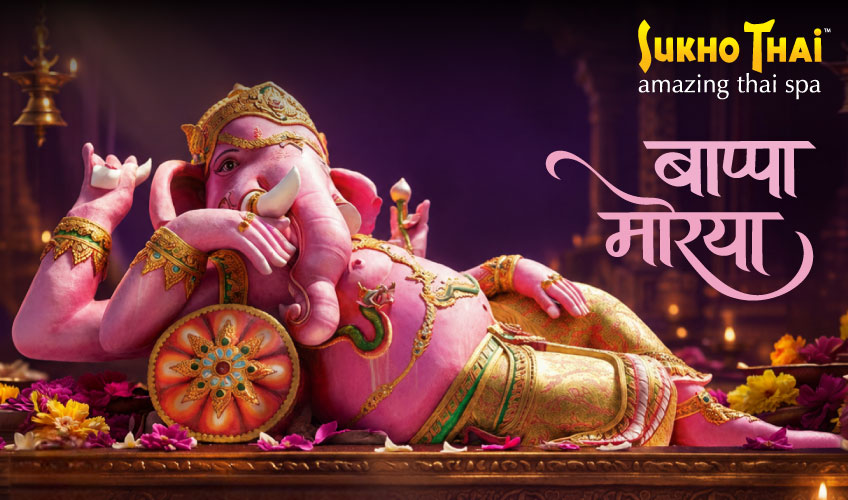
That idea of beginning well is where Lord Ganesha's form has always offered more than devotion. Long before anyone turns it into a wellness metaphor, his image is simply familiar: the large ears, the small watchful eyes, the single tusk, and that unhurried calm on his face. Sit with that form for a minute longer than usual, though, and it starts to say something quieter about how we might actually live not as religious instruction, but as the kind of observation a grandmother might make while helping shape the fiftieth modak of the evening.
What This Festival's Symbolism Can Offer Beyond Ritual
None of what follows claims to be scriptural interpretation. It is simply how many people have come to read Ganesha's form over generations as a set of visual cues for a well-lived, well-balanced life. Traditionally associated with wisdom and new beginnings, his image has quietly carried lessons that have very little to do with religion and everything to do with how a person gets through an ordinary Tuesday.
His Large Ears: The Discipline of Actually Listening
Ganesha's ears are large enough that they're often the first thing a child notices and asks about. For many people, this proportion is traditionally read as a reminder to listen properly, not performatively to others, and just as importantly, to oneself.
Most of us are fairly good at hearing other people out. Where we tend to fail is in listening to our own signals. The stiffness in a shoulder that's been there for three weeks. The sleep that's been getting shorter and lighter without anyone noticing exactly when that started. The vague, low-grade tiredness that doesn't have a name, so it gets ignored rather than addressed. We push through these things not because we're careless, but because stopping to listen feels, somehow, like an inconvenience to everyone else's schedule.
The body rarely announces anything loudly at first. It tends to whisper before it insists. Wellness, in a very unglamorous sense, is mostly the habit of catching that whisper early, responding with a bit of rest or a proper night's sleep, rather than waiting for the body to make its point more forcefully and answering it then with guilt instead of care.
His Small, Focused Eyes: What It Means to Pay Attention
Compared to the size of his ears, Ganesha's eyes are small and deliberately focused, a detail that's often understood as a reminder about attention. Not attention in the abstract sense, but the very specific, very ordinary struggle of trying to be in one place while your mind insists on being in six others.
A phone buzzes during dinner, and half the table's attention leaves the room without anyone physically moving. A person watches a film while replying to three different chats and later can't quite recall how it ended. None of this is a character flaw; it's just what a constant stream of notifications does to anyone's attention span over time.
Focus, in this reading of the symbolism, isn't about achieving some perfect meditative state. It's smaller and more workable than that: one conversation without a phone in hand, one meal eaten without a screen nearby, and one breath taken slowly enough actually to notice it happening. Small, ordinary returns to the present, repeated often enough to feel less like effort and more like habit.
Ganesha's Calm Expression: The Space Between Reaction and Response
Ganesha is rarely depicted with an anxious or agitated expression. His calm is steady rather than blissed out, and that steadiness is often taken as a lesson in composure: the difference between reacting to something immediately and choosing, even briefly, how to respond to it.
It's worth being honest about what calm actually is here, because it's easy to misread it as the absence of difficulty. It isn't. Calm doesn't stop the traffic jam, the difficult email, or the argument that started over something trivial and somehow grew legs. What it can do is create a small gap a breath, a pause, a moment of not saying the first thing that comes to mind between the difficulty arriving and a person's response to it.
That gap is where most of the actual choosing happens. Without it, reactions tend to run on autopilot, shaped by whatever mood happened to be sitting closest to the surface. With even a few seconds of pause, a response becomes something closer to a decision. This isn't a claim that anyone can simply will themselves into permanent calm. It's smaller than that practice of building in that pause a little more often than not.
The Single Tusk: Choosing What to Carry and What to Set Down
One of Ganesha's tusks is broken, and this detail is commonly understood as a symbol of sacrifice: retaining what serves a purpose and letting go of what has already served its purpose and doesn't need to be carried further.
Most people accumulate more than physical tiredness over the course of a year. There's the old disagreement that never quite got resolved, replayed on loop long after the other person forgot about it. There's the quiet pressure to be endlessly available to family, to work, and to friends who need "just five minutes" that somehow become an hour. There's the guilt that shows up whenever rest is chosen over one more task on the list.
Letting go, in this context, isn't the same as pretending difficult feelings don't exist or suppressing them until they resurface somewhere worse. It's closer to a sorting exercise: deciding, with some honesty, what actually deserves a person's attention this week and what has simply been carried out of habit. Some of what we hold onto genuinely matters. A fair amount of it doesn't, and never really did; it just never got put down.
The Remover of Obstacles: Why Beginnings Don't Need to Be Dramatic
Ganesha's most widely known role is as Vighnaharta, the remover of obstacles invoked before starting anything new, from a wedding to a business to, in some households, an exam. It's a role built entirely around the idea that beginnings matter and that they deserve a clear path rather than a grand one.
This is worth remembering when it comes to health, because a lot of people quietly assume that taking their well-being seriously has to start with something dramatic: a complete diet overhaul, a punishing new gym routine, or a sudden and total digital detox. Most of those attempts don't survive past a fortnight, not because the person lacks willpower, but because the starting point was simply too heavy to sustain.
A more realistic beginning tends to be smaller and considerably less impressive on paper: going to bed twenty minutes earlier. A short walk instead of another episode. Drinking a glass of water before the day's first cup of chai instead of after it. Sitting through one full breath without immediately checking a phone. None of these will make a dramatic story, but repeated with any consistency, they tend to add up to something that actually holds.
Health Is Wealth, and Why That Isn't Just a Saying
There's an old phrase that gets repeated so often it risks becoming background noise: health is wealth. It's easy to hear it and move on without really sitting with what it means. But strip away the cliché, and the observation underneath is fairly sound: whatever a person builds, earns, or achieves only really counts for something if they have the energy and clarity left to enjoy it.
A promotion means less when it arrives alongside chronic exhaustion. A long-planned holiday loses some of its shine if a person spends most of it too depleted to actually be present for it. Ganesh Chaturthi's spirit of positive beginnings sits naturally alongside this idea, because a beginning is only as good as the state a person is in to meet it. Wishing for prosperity without also making a little room for well-being is, in a sense, only wishing for half of it.
A Healthier Routine Can Begin With One Ordinary Decision
None of the changes above need to happen all at once, and none of them need an audience to matter. A healthier routine can start with something as unremarkable as switching off the phone half an hour before bed or choosing the stairs on a day when there's no particular rush. It can be as simple as making time to sit outside for ten minutes without any task attached to it, or finally booking the massage that's been postponed for three months because there was always something more "urgent" competing for the slot.
The point isn't the size of the decision. It's that the decision actually gets made and gets repeated often enough to stop feeling like an exception and start feeling like how things are done. A festival built around beginnings is, if nothing else, a fairly good nudge to pick one and get on with it.
Where SukhoThai Fits Into This Idea of Beginning Again
This is roughly where a brand like SukhoThai comes into the picture, not as the solution to everything discussed above, but as one practical way to act on it. SukhoThai has spent more than fifteen years bringing Thai-inspired wellness practices to Indian cities, built around a fairly simple premise: that the body holds tension in specific places, and that trained hands, applied with patience, can help release it.
Guests can choose from a wide range of SukhoThai's therapies, from the everyday relief of a Thai Traditional Foot Massage to the warmth of a Foot Massage with Hot Stones or the aromatic, herb-steamed comfort of a Foot Massage with Herbal Compress. None of these is presented as medical treatment, and they aren't meant to be. What they offer is simpler and, in its own way, harder to come by: an hour where nobody needs anything from you, in a room built specifically to be quiet.
That combination of trained technique and unhurried surroundings is roughly where the health benefits of Thai therapy tend to show up: better sleep, eased muscle tension, and a mood that lifts a little once the body stops holding its usual tightness. The session itself might last sixty or ninety minutes. What people often notice is that the sense of ease it leaves behind tends to outlast the appointment by quite a bit.
Why People Keep Coming Back
Walk into most SukhoThai locations on a weekday evening, and you'll notice something: a fair number of the guests aren't first-timers. They're people who've been coming for months, sometimes years, often to the same branch, and occasionally asking for the same therapist by name. That kind of familiarity doesn't happen by accident. People tend to return to places where they feel recognised, where the room is quiet in the way they remember it being quiet, and where the care on offer doesn't waver from one visit to the next.
Over time, that regularity is what shifts wellness from being an occasional indulgence into something closer to routine maintenance, the same way a person gets used to a regular check-up, except this one tends to be considerably more pleasant. With SukhoThai locations now spread across Mumbai, Pune, Goa, Bangalore, Kashmir, and Kathmandu, that kind of routine is easier to keep up wherever life happens to take someone next.
It isn't only regular guests who've found their way to SukhoThai over the years. The brand's Celeb Talk page carries a fairly long list of faces from television, film, and music who've stepped in for the same reason as everyone else: a demanding schedule and a need to switch off for an hour. It's a useful reminder, if you need it, that the desire to pause and recover isn't reserved for any particular kind of life. Busy is busy, whether the calendar is full of shoots or school pickups.
This Ganesh Chaturthi, Let the Obstacle Being Removed Be the One in Your Own Routine
Every year, Ganpati Bappa is welcomed as the one who clears the way for what comes next. It's worth extending that idea a little further than the usual wishes for success and prosperity to the obstacles that stand quietly between people and their own well-being. The habit of ignoring tiredness until it becomes a problem. The overthinking that refuses to switch off after ten at night. The belief that rest has to be earned before it's allowed.
May this festival bring good health, a little more ease, and the sense that a positive beginning is available at almost any moment someone is willing to take it, not just on the days the idol is home, but on the ordinary Tuesday that follows.
This Ganesh Chaturthi, make a little room for yourself. Book an appointment at a SukhoThai near you, browse the season's SukhoThai offers, or consider a SukhoThai gift card for someone whose "I'll rest later" has gone on a little too long. Sometimes the simplest way to begin again is exactly that simple: pause, breathe, and let someone else's care do the rest for an hour.
Ganpati Bappa Morya.
Popular Post
The Wisdom of Lord Ganesha: Lessons in Calm, Balance, and Positive Beginnings
Sep 14, 2026Copyrights © 2010 - 2026 SukhoThai India Pvt. Ltd. - All Rights Reserved