
SukhoThai Blogs
Unlock insights with our recent articles

 Jul 2026
5 Signs You're Overdue for a Spa Visit
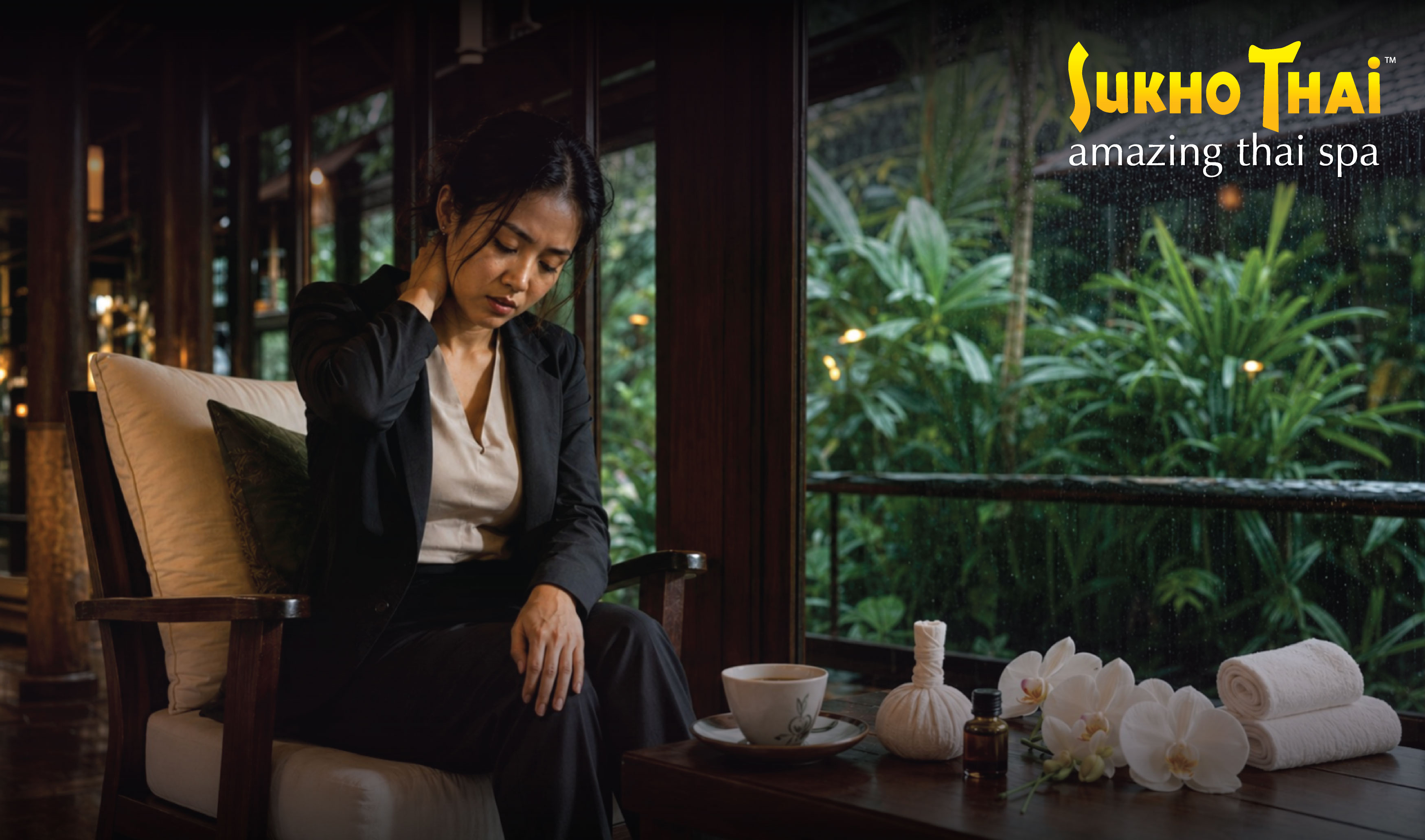
The umbrella flips inside out the second you step off the train. Your shoes are soaked before you've reached the office, and your shoulders have crept up toward your ears without your permission. By Friday, you're not sure what hurts more: your back from hunching at a desk or your feet, damp since Tuesday.
If this sounds familiar, you're not imagining it. Humidity, dropping air pressure, and reduced movement all quietly change how your body feels during a monsoon. None of it happens overnight, and none of it feels serious enough on its own to do anything about. That's exactly the problem. Below are five signs your body is asking for attention, what's actually causing them, and which therapy addresses each one directly.
Why Monsoon Is Harder on Your Body Than You Think
It isn't just the rain. Lower air pressure during monsoon is linked to increased joint and muscle sensitivity, which is why old injuries or tight spots seem to flare up for no clear reason. Add in fewer daylight hours, and your body's internal clock, the one that regulates energy and mood, gets thrown slightly off course. On top of that, most people move less. Walks get skipped, commutes get rushed, and workouts get postponed "until the weather clears." The result is a body that's tense, under-moved, and quietly running on less than usual long before anything feels like an actual problem.
There's also a behavioural pattern that makes this worse: a monsoon changes how you carry yourself without you noticing. You walk differently on wet, uneven roads: shorter steps, more caution, and more weight shifted onto your calves and ankles to avoid slipping. You sit differently when you're cold, pulling your shoulders in for warmth. None of these adjustments is conscious, and none of them undoes themselves once the rain stops for the day. They carry over into the next commute, the next desk session, and the next damp evening, which is why monsoon tension tends to feel cumulative rather than tied to any single bad day.
The 5 Signs
1. Your Shoulders and Neck Feel Tight, Even After Sleeping
Damp, cold weather triggers an instinctive response: shoulders rise, necks tuck in, and posture curls inward the same way you'd brace against wind. Now add hours spent hunched over a laptop, a phone, or handlebars, and those muscles stay semi-contracted long after the actual cause is gone. Sleep doesn't reset this. A muscle that's been locked in one position all day doesn't relax just because you lie down; it needs to be worked out of that pattern.
This is where Neck & Shoulder Therapy is built for exactly this problem: targeted pressure and stretching through the upper back, neck, and shoulders to release tension that's settled in, not just surface-level tightness.
2. Your Feet Ache by Evening
Wet, uneven surfaces and damp shoes reduce the natural cushioning your feet normally rely on. Every step sends slightly more impact up through your ankles and calves than it would on dry ground. Over a full day of walking on monsoon streets, that adds up, which is why your feet can feel disproportionately sore by evening, even if you haven't walked more than usual.
This is squarely what Thai Traditional Foot Massage and Foot Massage with Mineral Salt are designed to address, working through the soles, arches, and calves to release the kind of deep, accumulated fatigue that a regular day on your feet leaves behind.
3. You're Tired Without Doing Much
Less sunlight affects your internal clock and, by extension, your mood and alertness. At the same time, lower activity levels, fewer walks, and less incidental movement mean your body isn't producing the natural energy boost that movement provides. The combination is why you can end a low-effort day feeling more drained than a busy one.
Circulation-focused therapies like a normal body massage or body massage with strawberry scrub help here. Improved blood flow is one of the more direct ways to counter the sluggishness that comes with reduced movement and lower light exposure.
4. You Can't Fully Relax or Sleep Well
Disrupted routines, later commutes, indoor evenings, and less consistent schedules combined with muscle tension that never fully resolves keep your nervous system mildly "on." This is the physiological reason deep rest feels harder to reach during monsoon, even when you're objectively getting enough hours of sleep.
A Royal Thai Signature Therapy session, which works the full body rather than one area, is built around the same principle Thai wellness has followed for centuries: the nervous system settles when muscular tension is addressed comprehensively, not in isolated spots.
5. You've Noticed You're Stiffer Than Usual
Cooler, damp conditions reduce muscle elasticity, and when you're also moving less, joints don't get taken through their full range as often as they normally would. Stiffness compounds a joint that isn't moved fully; today is a little stiffer tomorrow and a little more the day after.
Foot massage with hot stones and foot massage with herbal compress work well against this specific pattern. Heat increases blood flow and loosens tissue, while compress therapy adds targeted pressure, a combination that's particularly effective when cold, damp weather is the underlying cause.
Why It's Worth Acting on These Signs Early
None of these five signs is dramatic on their own. That's exactly why they build up. Tight shoulders don't stop you from working. Tired feet don't stop you from walking. Low energy doesn't stop you from getting through the day. But left unaddressed through an entire season, these small, ignorable things compound into the kind of chronic tension that takes far longer to undo. Preventive care is consistently easier and cheaper, in terms of time and effort, than recovery after the fact.
Sukho Thai: Built on a Different Idea of Wellness
For over 15 years, Sukho Thai has brought authentic Thai wellness traditions to India. Thai healing practices have never treated massage as an occasional indulgence; the tradition is built on the idea that circulation, prevention, and balance matter more than reacting to pain once it's already there. That's the same principle behind every therapy on our menu, whether it's a full-body session or a foot-specific treatment.
Our therapists are trained in traditional Thai massage techniques, a practice that combines acupressure, assisted stretching, and rhythmic pressure to work with the body's own energy lines, rather than just addressing surface muscle. It's a different approach from a typical spa treatment, and it's one reason clients come back through every season, not just monsoon.
How Traditional Thai Massage Techniques Actually Work
Most people know Thai massage is "different" from a standard spa massage, without knowing exactly why. The core difference is technique. Where a typical body massage relies mainly on kneading and gliding strokes, Thai massage combines acupressure, firm, sustained pressure along specific points of the body, with assisted stretching that moves joints and muscles through ranges of motion you wouldn't reach on your own. Warm compress and hot stone techniques add a heat component on top of that, which is particularly useful in monsoon: heat increases local blood flow, and better circulation is one of the most direct ways to loosen tissue that's stiffened from cold, damp conditions.
This is also why a foot massage in this tradition tends to affect more than just the feet. Pressure-point work through the soles and lower legs is connected, in Thai practice, to broader circulation and the relaxation response, which is part of why clients often report feeling looser in the shoulders or clearer in the head after a session that was, technically, focused on their feet.
Our Full Range of Therapies
Whichever sign matches what you're feeling, there's a therapy built around it:
-
Normal Body Massage: A full-body session for general tension and circulation, suited to anyone who needs an overall reset rather than targeted work.
-
Body Massage with Strawberry Scrub combines: Full-body massage with exfoliation, addressing muscle tension and dull, monsoon-dampened skin in one session.
-
Mango Scrub with Body Massage: a similar combined approach using mango-based exfoliation for muscle relief alongside skin renewal.
-
Foot Massage with Mango Scrub: Focused foot therapy paired with exfoliation, suited to feet that need both relief and skin care after wet-weather exposure.
-
Foot Massage with Back, Head, and Shoulders: A foot session extended to cover the upper body, ideal when tiredness and stiffness show up in more than one place at once.
-
Foot Massage with Herbal Compress uses heated herbal compresses to work into deep foot and calf tension, which is particularly effective for stiffness caused by cold, damp conditions.
-
Foot Massage with Hot Stones: a heat-based therapy that loosens tight muscle tissue in the feet and lower legs faster than pressure alone.
-
Foot Massage with Mineral Salt incorporates mineral salt for circulation and skin health alongside standard foot therapy techniques.
-
Foot Massage with Scrub: a straightforward combination of exfoliation and foot massage for anyone who wants relief without a longer session.
-
Thai Traditional Foot Massage: the foundational therapy, using traditional pressure-point techniques through the feet and lower legs; this is the therapy this practice is best known for.
Which Therapy Fits Which Sign
If you're short on time and just want a direct answer:
-
Tight shoulders and neck → Neck & Shoulder Therapy
-
Aching feet by evening → Thai Traditional Foot Massage or Foot Massage with Mineral Salt
-
Low energy, no clear cause → Normal Body Massage or Body Massage with Strawberry Scrub
-
Trouble winding down or sleeping → Royal Thai Signature Therapy
-
General stiffness → Foot Massage with Hot Stones or Foot Massage with Herbal Compress
Frequently Asked Questions (FAQs)
How often should you get a massage during monsoon? There's no fixed rule, but once every two to three weeks during monsoon is a reasonable baseline for most people who are on their feet daily or working desk-heavy hours. If you're noticing two or more of the five signs above consistently, that's a signal to book sooner rather than wait it out.
Which massage is best for stiff shoulders from desk work? Neck & Shoulder Therapy is built specifically for this it targets the upper back, neck, and shoulder muscles that stay contracted from long hours at a screen, which general full-body sessions don't always address as directly.
Does foot massage actually help with monsoon fatigue? Foot massage improves circulation through the lower legs, which is where fatigue and swelling tend to settle after a day of walking on wet or uneven ground. Traditional Thai foot massage in particular works pressure points that are linked to overall relaxation, not just the feet themselves.
Is Thai massage good for general muscle stiffness or only for specific injuries? Thai massage techniques are built around whole-body circulation and assisted stretching, which makes them suited to general stiffness, the kind caused by cold weather or reduced movement, as much as to any single sore spot.
Where can I get a Thai massage in Mumbai? Sukho Thai has a location in Mumbai offering the full range of therapies listed above, from foot-specific treatments to full-body sessions. You can find details and book a slot through the link below.
How long does a typical session take? It depends on the therapy; a focused foot treatment is usually shorter than a full-body session like the Royal Thai Signature Therapy, which is designed to work the entire body rather than one area. If you're short on time but dealing with a specific issue, such as sore feet or tight shoulders, a targeted therapy is usually the more efficient choice.
Is it fine to get a massage if you're feeling under the weather, not just tired? Mild fatigue or muscle tension is exactly what these therapies are built for. If you're dealing with an active fever, infection, or illness, it's worth waiting until you've recovered and mentioning any current health concerns to your therapist before the session either way.
Sukho Thai Across India
Sukho Thai Mumbai: https://www.sukhothai.in/city/mumbai
Sukho Thai Pune: https://www.sukhothai.in/city/pune
Sukho Thai Goa: https://www.sukhothai.in/city/goa
Sukho Thai Bangalore: https://www.sukhothai.in/city/bangalore
Sukho Thai Kashmir: https://www.sukhothai.in/city/kashmir
Sukho Thai Kathmandu: https://www.sukhothai.in/city/kathmandu
Quick Recap
1. Monsoon affects your body through humidity, lower air pressure, reduced sunlight, and less movement, even if you're not doing anything differently.
2. Tight shoulders, sore feet, low energy, poor sleep, and general stiffness are the five early signs worth acting on.
3. Each sign has a specific therapy built for it; this isn't about picking any massage; it's about picking the right one.
4. Sukho Thai has offered traditional Thai wellness therapies in India for over 15 years, built on circulation, prevention, and balance.
If even one of these five signs sounds familiar, that's your answer.
Book a session at Sukho Thai and let a therapy built for exactly this season do its job.
Popular Post
5 Signs You're Overdue for a Spa Visit
Jul 23, 2026Copyrights © 2010 - 2026 SukhoThai India Pvt. Ltd. - All Rights Reserved